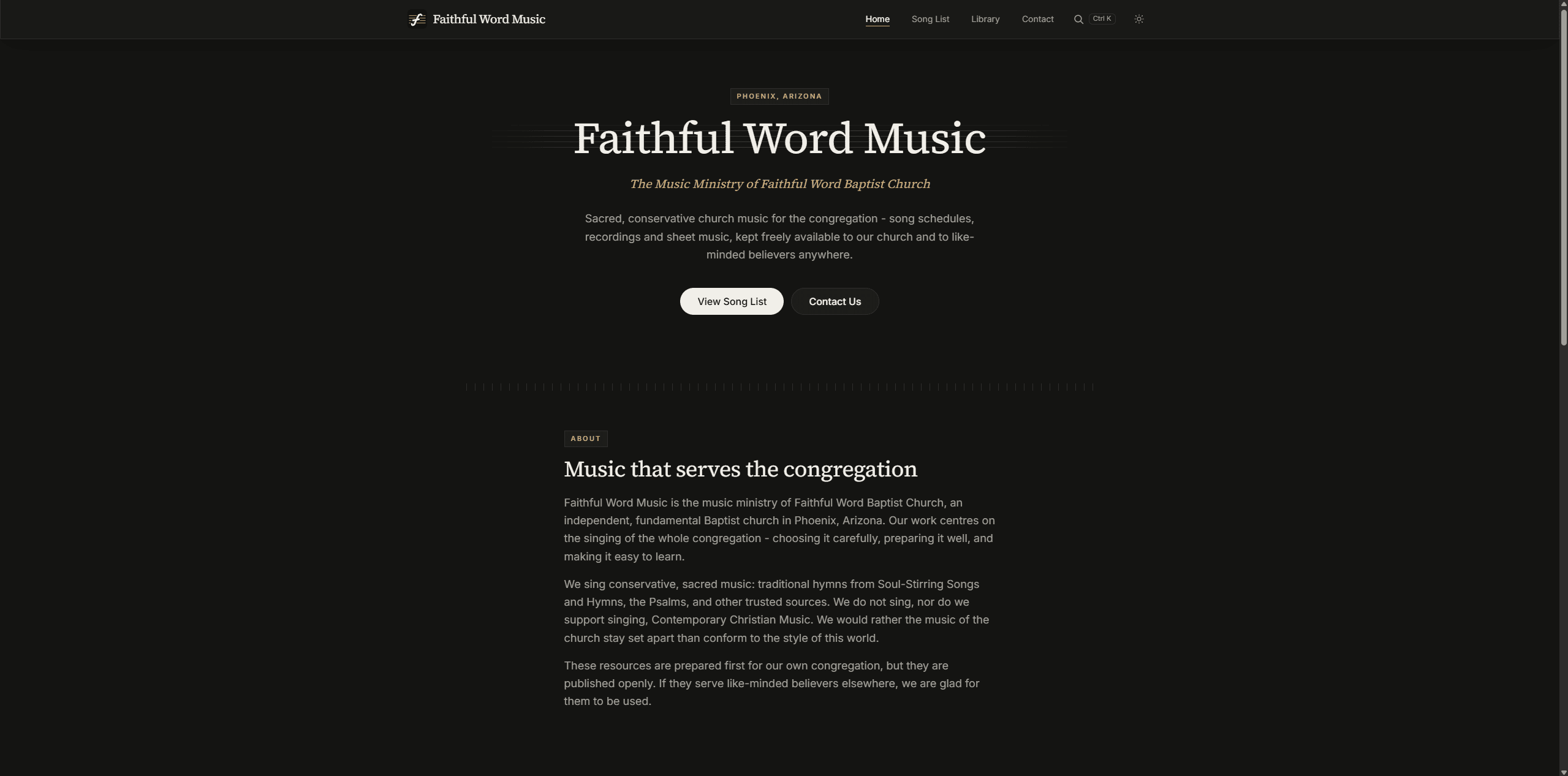
Overview
A full-stack music ministry management platform featuring AI-assisted service planning, intelligent song search, real-time publishing, historical analytics, sheet music management, role-based access control, and push notifications. Built with Next.js, React, TypeScript, and PostgreSQL, the platform modernizes church music operations through an integrated, installable web application.
The Story Behind Faithful Word Music
Faithful Word Music is a full-stack web application I designed and developed to modernize the music ministry at Faithful Word Baptist Church in Phoenix, Arizona. What began as an effort to improve how congregational song lists were published evolved into a comprehensive platform for music planning, resource management, historical analytics, team coordination, and artificial intelligence.
Before developing the platform, several important workflows depended on disconnected Google Sheets, Google Drive folders, and manual processes. As Music Director, I wanted to simplify these responsibilities while creating a centralized resource that would benefit musicians, song leaders, church members, and visitors.
I built the application using Next.js, React, TypeScript, Tailwind CSS, and PostgreSQL hosted on Neon. The architecture combines a public-facing website with an authenticated management system, using server-side business logic, external service integrations, and modular application components to support long-term maintainability and growth.
One of the platform's central features is a custom Service Planner that replaces the previous spreadsheet-based workflow. Authorized users can create, edit, organize, archive, and publish congregational music plans directly within the application. Published plans automatically appear on the public song list without requiring code changes or redeployment.
The public website provides a searchable song library, historical service archives, detailed song statistics, sheet music resources, downloadable PDFs, and sharing tools. Individual song pages display historical usage, commonly used keys, and upcoming appearances, making the platform useful beyond simply viewing the current song schedule.
For authenticated users, I implemented personalized dashboards, musician availability management, administrative tools, and role- and permission-based access control. Clerk handles authentication, while application-specific authorization rules determine which features and resources each user can access.
One of the most technically involved aspects of the project was developing an integrated artificial intelligence system. The platform includes Conductor, an AI assistant that answers questions about the ministry's music history, service plans, song lyrics, and planning guidelines. Rather than inventing church-specific information, the assistant retrieves relevant facts through controlled application tools connected to the platform's own data.
I also developed a music intelligence system that extracts lyrics from MuseScore files, indexes them in PostgreSQL, and uses vector embeddings to enable semantic searches. This allows songs to be discovered by theme and meaning rather than relying exclusively on exact titles or keywords. Within the Service Planner, AI can generate song selections, suggest improvements, and evaluate plans using historical data and configurable planning guidelines, while keeping final decisions and publishing under human control.
The AI infrastructure also supports persistent conversations, explicitly controlled personal and global memory, versioned planning guidelines, and centralized usage and cost monitoring. These capabilities required careful consideration of data access, authorization, reliability, and the separation of AI-generated recommendations from authoritative application data.
To improve communication and accessibility, I implemented an integrated notification system supporting in-app messages, browser push notifications, configurable notification policies, individual preferences, and administrative messaging tools. I also developed the platform as a Progressive Web App (PWA), allowing users to install it on supported desktop and mobile devices.
Throughout development, I emphasized maintainable architecture, reusable components, server-side security, input validation, and automated testing. The application integrates services including Clerk for authentication, Google APIs for sheet music management, Resend for email, and Vercel AI Gateway for AI capabilities, with the production application deployed through Vercel.
Faithful Word Music has grown from a relatively simple website into a centralized production application that replaces manual workflows and provides practical tools for an active music ministry. Beyond its immediate purpose, the project has given me extensive experience designing, building, integrating, testing, and maintaining a complex full-stack system. It continues to evolve as new requirements emerge, with a focus on scalability, maintainability, and solving real-world problems through software engineering.
Development activity
Live data from the project’s public GitHub repositories, kept apart from the curated timeline.